 Login
Login

Patient Engagement and Messaging for Healthcare
Backline extends secure communication beyond the clinical encounter with patient messaging, voice, video, automated outreach, and configurable follow-up workflows.

Patient engagement workflows before and after care
From patient intake before a procedure to follow-up after discharge, Backline keeps organizations connected with patients when communication matters most.
High-Risk Post-Discharge Follow-Up
Identify patients who may need additional support after leaving the hospital and create a clearer path for follow-up.
High-Risk Post-Discharge Follow-Up
Identify patients who may need additional support after leaving the hospital and create a clearer path for follow-up.
Stay connected when patients go home
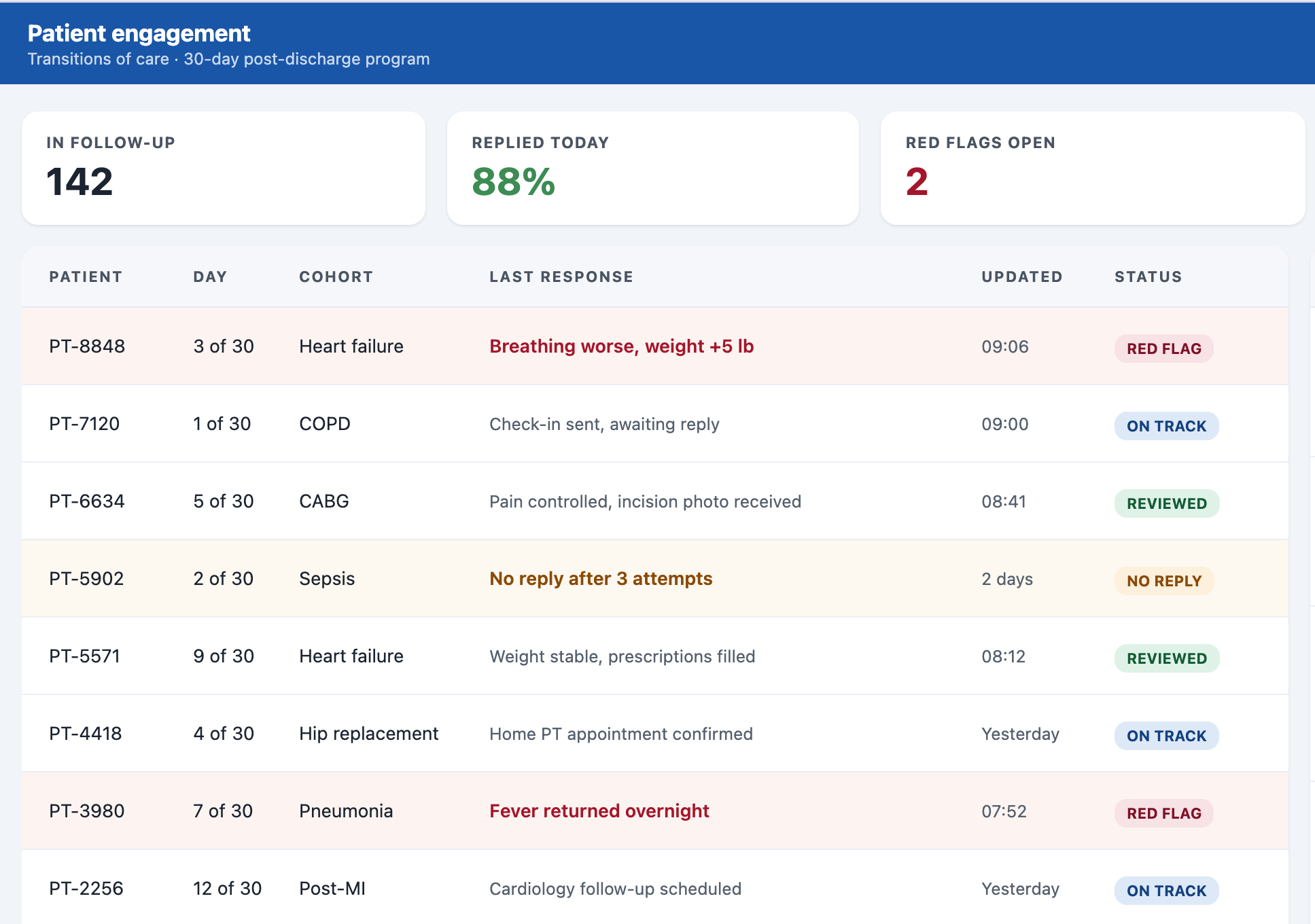
The days after discharge can create new questions, symptoms, medication concerns, or barriers to recovery. Backline supports structured outreach to high-risk patients and helps teams act when a response indicates additional follow-up is needed.
Scheduling Reminders
Keep patients informed about upcoming appointments and give them a way to respond when plans change.
Scheduling Reminders
Keep patients informed about upcoming appointments and give them a way to respond when plans change.
Make reminders more actionable
Pre-Procedure Prep
Deliver timely instructions before a procedure and help teams identify patients who may not be ready before their appointment time.
Pre-Procedure Prep
Deliver timely instructions before a procedure and help teams identify patients who may not be ready before their appointment time.
Help patients arrive prepared
Frequently asked questions
What is patient engagement in healthcare?
Patient engagement includes the communication and interactions that help patients participate in their care before, during, and after a clinical encounter.
How can healthcare organizations automate patient outreach?
Automated outreach can send messages based on predefined events or workflows, such as an upcoming appointment, procedure, discharge, or follow-up period.
What is two-way patient messaging?
Two-way patient messaging allows healthcare organizations to send information to patients while also giving patients a way to respond in a defined period of time with questions, updates, or concerns.
How does Backline support post-discharge follow-up?
Backline supports automated patient outreach, captures responses, and routes patients who may require additional follow-up to the appropriate care team.
Does Backline support pre-procedure communication?
Backline helps organizations send preparation instructions and reminders, receive patient responses, and coordinate follow-up when additional action is needed.
How is Backline different from one-way patient messaging?
Backline connects patient outreach with two-way responses and configurable follow-up workflows. When a patient replies with a question, concern, or other information, the response can be routed to the appropriate team so communication can continue into the next action.
Does Backline replace the patient portal?
No. Backline works alongside existing patient portals and clinical systems. It provides another way to support secure patient communication, automated outreach, and follow-up workflows before and after care.
Keep the patient connected to what happens next
Give patients an easier way to stay informed, respond, and participate in their care while giving teams a clearer way to manage the follow-up that comes next.