 Login
Login

Healthcare Calling & Telephony Built for Clinical Workflows
Backline brings voice into the same secure clinical communication environment your teams use to coordinate care.

Calling capabilities built for healthcare
Voice Intake
Capture the reason for the call and collect defined information without leaving the request trapped in voicemail.
Voice Intake
Capture the reason for the call and collect defined information without leaving the request trapped in voicemail.
Bring incoming calls into the clinical workflow
Backline gives healthcare organizations a way to receive voice communication and connect it to the teams responsible for responding.
Call Queues
Organize incoming calls and help teams manage who responds next.
Call Queues
Organize incoming calls and help teams manage who responds next.
Give teams visibility into incoming demand
Call queues organize calls by department, service, or workflow so requests are handled by the appropriate team rather than relying on a single phone or individual.
AI Transcription
Convert voice messages and conversations into written information teams can quickly review and act on.
AI Transcription
Convert voice messages and conversations into written information teams can quickly review and act on.
Spend less time listening and more time acting
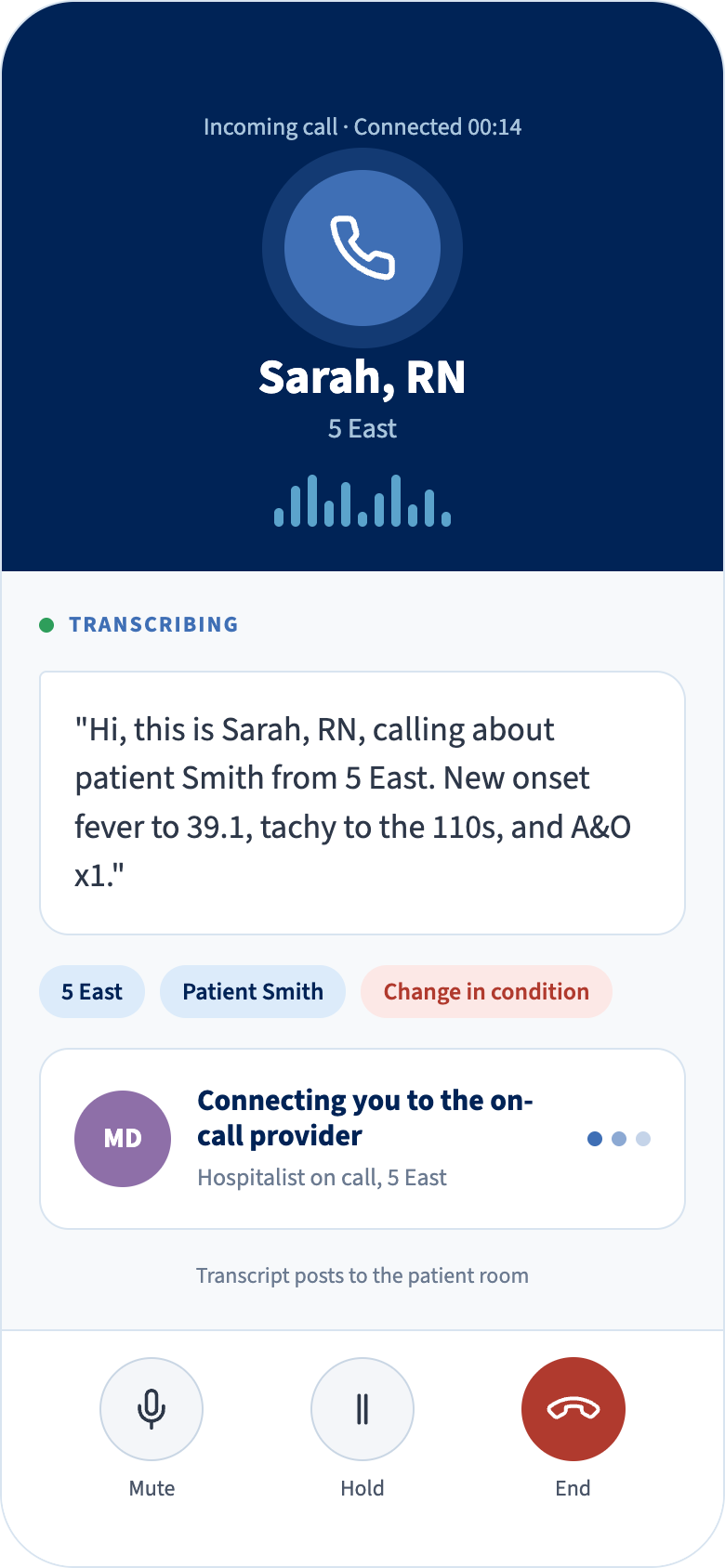
Backline uses AI transcription to turn voice into readable text, making it easier for clinicians and staff to understand why someone called without repeatedly listening to recordings.
On-Call Routing
Connect callers and incoming requests with the person currently responsible for a service or role.
On-Call Routing
Connect callers and incoming requests with the person currently responsible for a service or role.
Route by responsibility, not by individual
Instead of relying on static phone lists or manually determining who is covering, Backline routes communication based on the appropriate on-call role or service.
From voice intake and AI transcription to clinical action
Turn incoming calls and voice messages into information your teams can see, understand, and act on.
Backline captures the voice requests, generates a written transcription, and routes the information to the appropriate team or on-call role. Instead of leaving important information in a voicemail inbox, the request becomes part of a visible clinical communication workflow.
Frequently asked questions
What is clinical calling?
Clinical calling includes the voice communication workflows healthcare organizations use to receive, route, and respond to calls from patients, providers, care teams, and outside organizations.
How can AI transcription be used in healthcare calling?
AI transcription can convert voice communication into written text, helping authorized healthcare staff review incoming information more efficiently and use it as part of the appropriate workflow.
What is on-call routing?
On-call routing directs communication to the person currently responsible for a particular role, specialty, or service rather than requiring the sender to identify a specific individual.
How do call queues support healthcare teams?
Call queues can organize incoming calls by department, team, or service and provide greater visibility into requests waiting for a response.
Can Backline connect phone calls with secure clinical communication?
Backline brings voice intake, transcription, routing, and secure communication together so information from a call moves into the appropriate clinical workflow.
How is clinical calling different from a traditional phone system?
Traditional phone systems focus primarily on connecting calls. Backline connects voice communication with secure clinical communication and workflow capabilities such as call queues, AI transcription, role-based routing, and on-call workflows so information from a call continues into the work that follows.
Can Backline route calls based on who is currently on call?
Backline supports routing based on on-call roles or services so incoming communication reaches the person currently responsible rather than relying only on static phone lists or individual numbers.
Bring voice into the clinical workflow
Phone calls remain an important part of healthcare communication. Backline helps organizations connect calling with the people, information, and workflows required to move the request forward.