 Login
Login

Time-Sensitive Clinical Alerts
Backline routes critical alerts to the appropriate clinician or team, tracks acknowledgment, and escalates when defined response requirements are not met.

Built for time-sensitive clinical alert workflows
From critical results to emergency response, Backline coordinates the communication and actions that follow urgent clinical events.
Critical Results
Route time-sensitive results to the appropriate clinician and maintain visibility from notification through acknowledgment.
Critical Results
Route time-sensitive results to the appropriate clinician and maintain visibility from notification through acknowledgment.
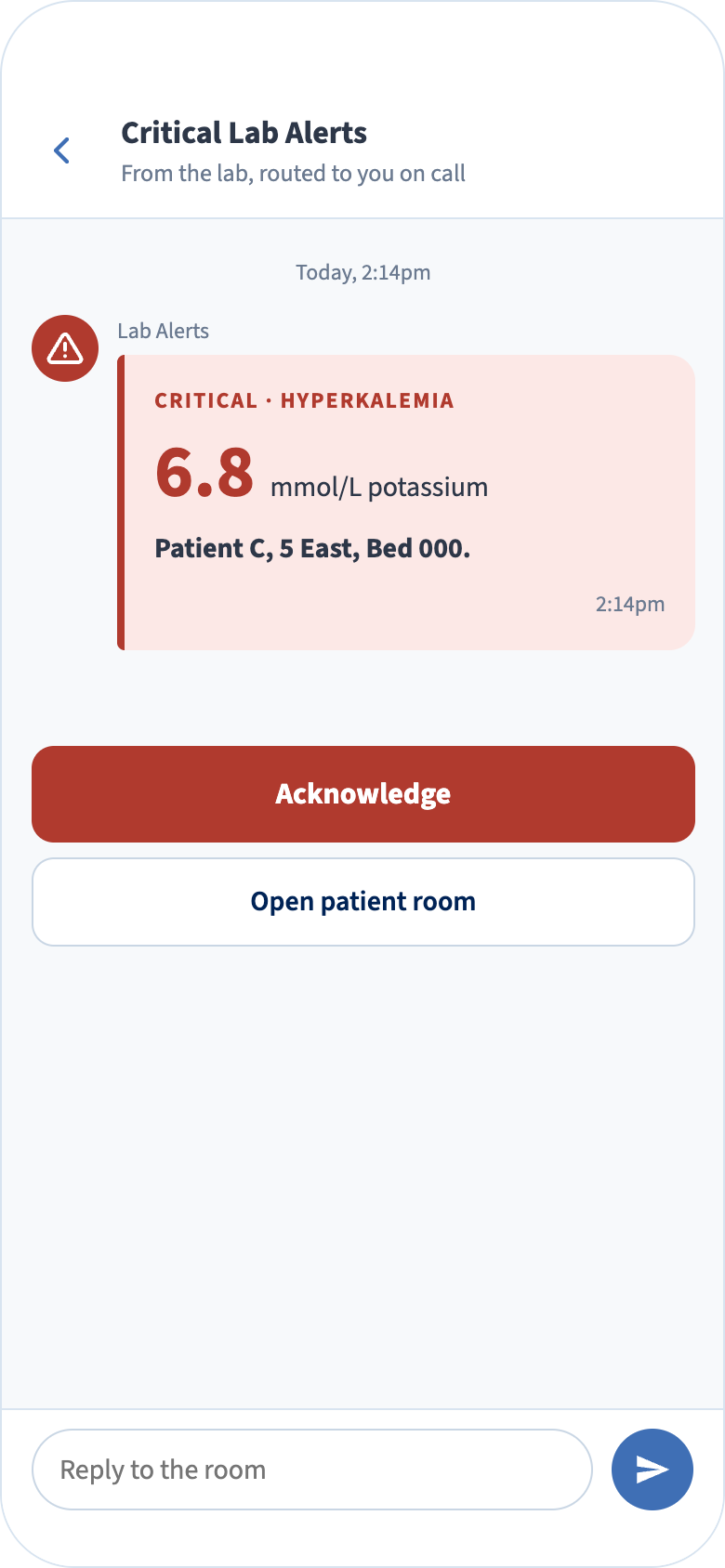
Close the loop on critical results
A critical result should not end with a page, phone call, or message.
Backline routes results to the appropriate clinician or role, provides visibility into delivery and acknowledgment, and escalates according to your organization’s workflow when follow-up is needed.
STEMI Response
Bring the teams involved in STEMI response into a coordinated workflow.
STEMI Response
Bring the teams involved in STEMI response into a coordinated workflow.
Mobilize the right teams quickly
STEMI response requires rapid coordination across the emergency department, cardiology, cath lab, nursing, transport, and other teams. Backline distributes time-sensitive notifications and gives teams shared visibility into the response.
Rapid Response
Coordinate urgent communication when a patient’s condition changes and immediate support is needed.
Rapid Response
Coordinate urgent communication when a patient’s condition changes and immediate support is needed.
Connect the response team around the event
Backline notifies the appropriate rapid response roles and provides a shared communication channel for updates as the event unfolds.
Medication Storage & Temperature-Excursion Alerts
Notify the appropriate team quickly when medication storage conditions fall outside the expected range.
Medication Storage & Temperature-Excursion Alerts
Notify the appropriate team quickly when medication storage conditions fall outside the expected range.
Turn an alert into a coordinated response
A temperature excursion can require rapid communication, investigation, documentation, and decisions about medication viability. Backline routes alerts to the appropriate team and coordinates the actions that follow.
Frequently asked questions
What are critical clinical alerts?
Critical clinical alerts are time-sensitive notifications related to clinical results, patient deterioration, emergency events, or other situations that may require prompt review or action from a healthcare professional.
How does Backline support critical result communication?
Backline routes critical results to the appropriate clinician or role, provides visibility into delivery and acknowledgment, and supports escalation when a response has not occurred within the expected timeframe.
What is alert escalation?
Alert escalation routes a notification to another appropriate person or role when the initial recipient does not acknowledge or respond within a defined period.
Can Backline support emergency response teams?
Backline notifies and coordinates teams involved in time-sensitive workflows such as STEMI and rapid response events while maintaining a record of communication and acknowledgment activity.
Can teams see whether a critical alert has been acknowledged?
Backline provides visibility into message and alert status so teams can better understand whether critical information has reached the intended recipient.
How is Backline different from a basic clinical alert or notification system?
A basic notification may only deliver information. Backline connects alerts with role-based routing, acknowledgment visibility, escalation, and secure clinical communication so teams have greater visibility into what happens after the alert is sent.
Does Backline replace the EHR or clinical monitoring system?
No. Backline works alongside the clinical systems that generate or contain patient information. It routes time-sensitive communication and coordinates the response workflow while the EHR or other designated system remains the clinical system of record.
From notification to response
Backline works alongside the systems that generate clinical results and alerts, connecting time-sensitive communication with routing, acknowledgment, escalation, and response coordination.
We'll map how alerts are received, routed, acknowledged, and escalated today and identify where Backline can create clearer ownership and visibility.