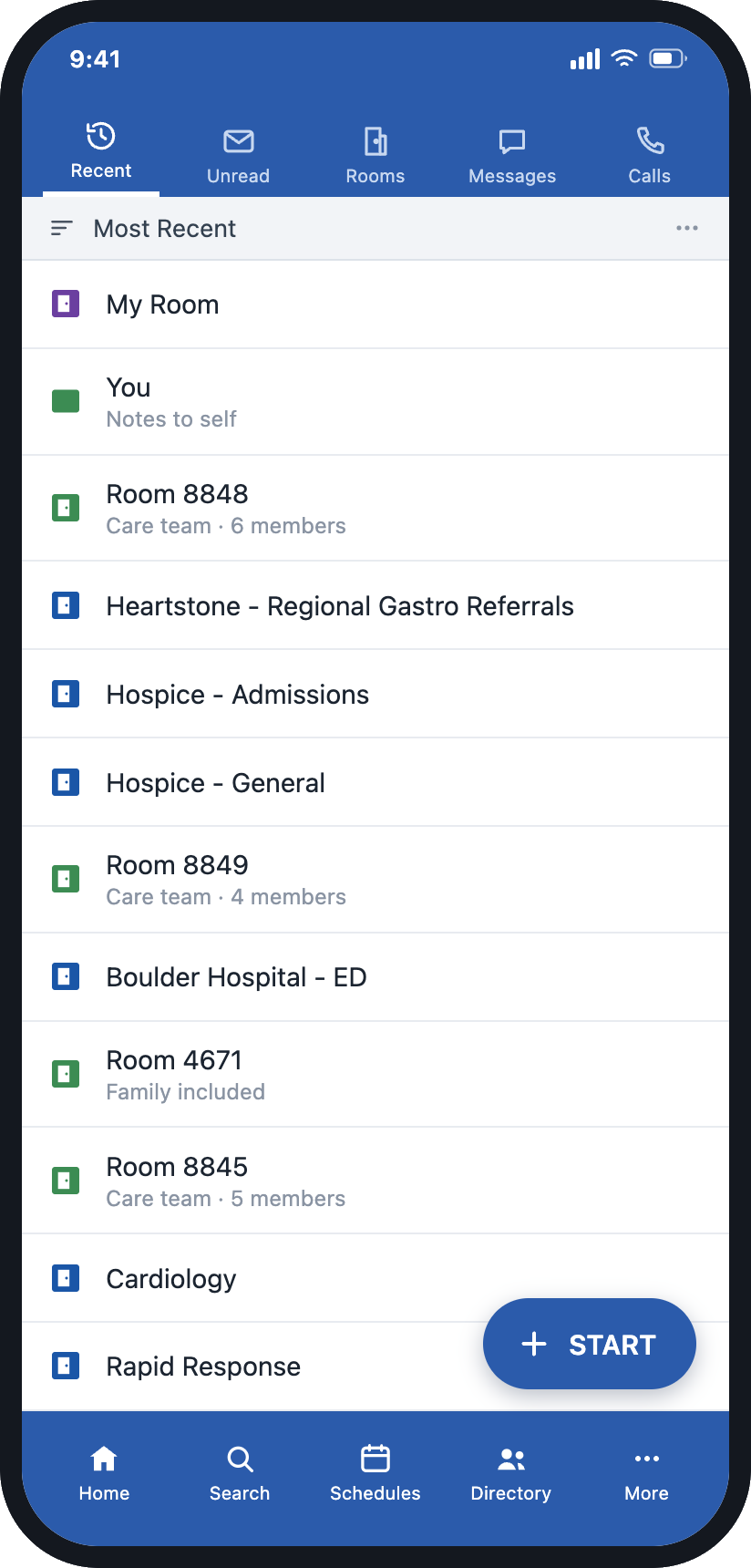
A secure platform gives healthcare organizations greater control over how users access information, how communication is retained, and how activity can be reviewed.
When should healthcare teams use secure messaging?
Secure messaging is useful when people need to exchange protected information, provide context, ask a question, or communicate asynchronously. It is not the best channel for every situation.
Communication need
Channel to consider
Brief, nonemergency clinical question
Secure message
Information that can be reviewed asynchronously
Secure message
Immediate, interactive discussion
Phone, video, or in-person conversation
Urgent team awareness
Prioritized alert or established emergency process
Formal clinical documentation
EHR or other designated system of record
Patient instructions or follow-up
Portal, secure message, phone, or video according to policy
Multi-step request
Secure communication connected to a defined workflow
Teams may move between channels. A secure message may lead to a call, and a call may require documentation or follow-up. Organizations should define which channels fit common situations, how urgency is communicated, and when acknowledgment is required.
What should a clinical message include?
A useful clinical message gives the recipient enough information to understand the situation and determine what is expected. Depending on the purpose, it may need to identify:
✓The patient or subject of the communication
✓The reason for the message
✓Relevant clinical or operational context
✓The level of urgency
✓Whether the sender needs awareness, acknowledgment, a decision, or an action
✓When a response is expected
✓The next step if the recipient is unavailable
A sample message
Situation
Rm 412 — new-onset a-fib, rate in the 130s.
Background
Vitals and the most recent EKG are attached.
Assessment
Stable, but the rate is not improving.
Request
Requesting cardiology evaluation this shift. Please acknowledge.
Structured communication practices such as SBAR — Situation, Background, Assessment, and Recommendation or Request — can help teams organize information consistently. Message templates may also help with repeatable use cases, but they should leave room for clinical judgment and patient-specific details.
Sending a message is not the same as confirming understanding or completion.
When a request is time-sensitive or actionable, the process may also need acknowledgment, alternate coverage, escalation, or confirmation that the next step occurred.
Is secure messaging HIPAA compliant?
A secure messaging platform can provide safeguards that support an organization's HIPAA compliance program. However, no individual technology makes an organization automatically compliant.
The HIPAA Security Rule requires covered entities and business associates to use appropriate administrative, physical, and technical safeguards to protect electronic protected health information. Organizations must consider how information is transmitted, accessed, stored, retained, and managed. [1]
When evaluating a platform, consider:
✓Encryption and other protections for transmitted and stored information
✓User authentication, access controls, and access removal
✓Device, application, and session management
✓Audit history and retention settings
✓Security-risk assessment and incident processes
✓Whether the vendor will enter into an appropriate business associate agreement
HHS permits healthcare providers to communicate electronically with patients when reasonable safeguards are applied. The appropriate method may depend on the information, channel, organizational policy, and patient preference. [2]
Can secure messaging connect the full care network?
Yes. Secure messaging can support communication among people inside and outside a hospital.
Internal care teams
Physicians, nurses, pharmacists, therapists, case managers, care coordinators, and operational teams.
On-call clinicians
The person currently covering a service, role, location, or specialty.
External care partners
Physician practices, skilled nursing facilities, home health agencies, pharmacies, behavioral health providers, EMS, and other authorized participants.
Patients and caregivers
People receiving instructions, forms, appointment information, education, follow-up, or virtual care.
The people involved in a patient's care do not always use the same organization, EHR, or communication system. Secure messaging can complement health information exchange by giving authorized participants a way to clarify questions and coordinate the activity surrounding shared information. [3]
Does secure messaging replace the EHR?
No. The EHR remains the clinical system of record. Secure messaging supports the conversations surrounding care, particularly when people need to connect quickly or work across departments, shifts, systems, and organizations.
Integrations can bring relevant patient information, directories, on-call schedules, alerts, and notifications into the communication process while keeping formal clinical documentation where it belongs. A platform may connect with:
EHR systems
On-call schedules and directories
Laboratory and medication alerts
Admission, discharge, and transfer notifications
Call center systems
Clinical and operational workflows
The goal is not to duplicate the medical record. It is to give people appropriate context and a clear way to communicate while maintaining defined documentation practices.
 Login
Login